
Competition Time…
August 11, 2016
annnddd the prize goes to…..
August 24, 2016HMS Boadicea, Warrior Queen
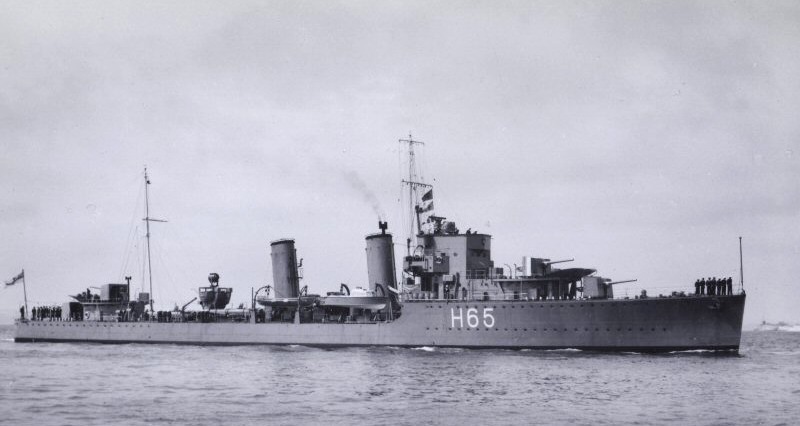
Sometimes it is difficult to appreciate links with past events. As divers when we dive wrecks we are in a very privileged position in which to see a snapshot of history. When a ship is sunk the damage done to it will inevitably be extensive and that is how it remains. It will then rust and decay, fishing gear gets tangled on it but essentially it is the same today as the day it sank.

White ensign flying on HMS Boadicea
I had joined a trip to dive the destroyer wreck HMS Boadicea from Ian Taylor’s Skin-Deep. This is a fantastic 54m dive, the wreck lies 13 miles South West of Portland Bill. It is an amazing story and a great wreck with lots to see on it. What made this trip a bit different was that Ian had been contacted by Stephen Carr, his uncle Jack Joseph was a stoker on the Boadicea and lost his life on that day, 13th June 1944.

Stephen Carr on Skin-Deep
HMS Boadicea was a B-class destroyer, she was built by Hawthorn Leslie on Tyneside. Ordered in 1929 & completed in 1931. She had a displacement of 1820 tons loaded, 98.5m long with a beam of 9.8m. She was powered by 2 Parsons steam turbines fed by 3 boilers producing 25000Kw of power this could propel her at a top speed of 35kts (40mph).

Divers on the deck
HMS Boadicea had a full and exciting history from the day she was commissioned in 1931, a real workhorse ship of the Royal Navy.
She was used to assist British troops in Palestine in 1935
HMS Boadicea evacuated civilians from Valencia at the outbreak of the Spanish Civil War. She had several missions to Spain to assist enforcing the Civil War arms embargo.
On the 29th August 1939 she was assigned to the 19th destroyer flotilla based at Dover. She supported the troopships of the British Expeditionary Force during October 1939.
On the 6th February 1940 HMS Boadicea carried Prime Minister Winston Churchill from Boulogne to Dover.

Diver illuminating the barrel of the aft 120mm gun
In March 1940 she towed the damaged oil tanker Charles F. Meyer into Southampton after that ship had struck a mine.
On the 9th June 1940 she went to Le Harve to take on British troops retreating from the German advance, the following day she was caught by a Stuka dive bomber that knocked out her engines and boilers. Boadicea was towed back to Dover and needed extensive repairs which lasted until February 1941.
She was involved in the search for German battleships Scharnhorst and Gneisenau.
Following this HMS Boadicea served as a convoy escort supporting Arctic convoys to Murmansk. Later to Gibraltar where she was also involved in the invasion of French North Africa, she also rescued 449 passengers & crew from liner RMS Viceroy of India.

Torpedo rack complete with one torpedo
Following this warm water deployment she returned to the Arctic convoys making a number of trips before returning to Freetown, Sierra Leone where she was involved in the rescue of 220 from torpedoed liner MV Incomati.
She returned to the Home Fleet in September 1943 for a refit. Completed in January 1944 she was able to support three more Arctic convoys before her final deployment to Portsmouth in preparation for Operation Overlord, the D-day landings.

close up of depth charge launcher
Seven days after D-day and while escorting a convoy of merchant ships across the Channel HMS Boadicea was caught by a Junkers Ju 88 medium bomber. The aircraft dropped 2 aerial torpedoes which struck the ship forward of the bridge and detonated a magazine. This explosion was catastrophic for the ship blowing off the bows, HMS Boadicea sunk quickly with only 12 of her crew being rescued. Her captain Lt Cdr F. W. Hawkins was lost along with Jack Joseph and 173 other sailors.

Loaded depth charge launcher with rack of depth charges behind
Not many of the wrecks we dive have as good a back story as this one, a wreck of great historical importance, she is a “protected place” as designated under the Protection of Military Remains Act 1986. Any diving is strictly looking only.
As we were preparing for the dive watched over by Stephen Carr a secondary story came to light, Stephen’s mother Elizabeth Carr nee Joseph and Jack’s sister had recently passed away, Stephen had requested that her ashes be taken down to the wreck so that she could finally be reunited with her brother Jack. Happily this was accomplished by Ian Taylor in addition to his raising of the white ensign on the wreck. Ian was diving not skippering on this trip.
As is often the way when wreck diving a lot of sitting around is followed by a flurry of activity and before you know it you are finning down the shot line.
The wreck came into view, the shot line caught on a lifeboat davit so it was easy to land at deck level and right beside one of the antiaircraft guns. This stood a couple of meters above the deck with a pedestal and platform, not difficult to imagine gunners frantically firing at the approaching aircraft.

20mm Oerkilon anti aircraft gun platform
The ship carried Oerlikon 20mm antiaircraft guns and it is one of these that is present, complete with barrel (so easily broken off by snagged fishing gear). Ian taylor would attach the white ensign to this gun. On the starboard deck ammunition for this gun lies scattered around.

20mm ammunition on the deck
Moving further aft past the above water 4 tube 21 inch torpedo launchers(with a live fish in the starboard tube). A skyward pointing 120mm (4.7inch) gun barrel appears next followed quickly by what look like a pile of dustbins until you realise they are depth charges. HMS Boadicea carried 20 depth charges and had 2 throwers on the rear deck. I think most of the depth charges are on or scattered around the wreck.
Reaching the square stern I dropped down to look at the rudder & two high performance propellors that are partially buried in the sea bed before returning to deck level to make my way forward. Amazing to see how compact the destroyer is with its firepower is all closely fitted together.

Diver lighting up the stern
I was able to watch Ian tie on the white ensign and take a number of photo’s for the record.

Ian Taylor with the white ensign he has just tied onto the anti aircraft gun
Forward of the AA guns the ship starts to show more damage. The engine and boilers are seen then abruptly it appears as if the ship had been chopped with an axe, a messy break that drops in steps to the sand. I could make out a shape in the gloom and a few meters further on, it was a forward 120mm gun, its barrel pointing impotently at the sand. The visibility wasn’t good enough to go any further, I suspect there is something of a debris field present but I didn’t want to loose site of the main wreck.

Forward 120mm gun with barrel in the sand
Returning to the deck it was time to bag off the wreck and spend some time on deco with my own thoughts about this amazing wreck and Jack Joseph and the other men lost on her in 1944.
Boadicea had certainly lived up to her contemporary title – Warrior Queen. More information can be found here: on Wikipedia
For completion I was using an inspiration rebreather, 10/52 diluent. Max depth was 54m, I did a bottom time of almost 40 minutes & was able to surface safely at a fraction over 90 minutes. Dive times had been limited to 90 minutes because of the surface conditions. My Ri1-100 kept me warm & dry! Pics were taken with a Nikon D610 in a Nauticam housing apart from the one below which was taken on an iPhone!

Going home!
It doesn’t end here this wreck is tied up with one of the real pioneers of UK diving; Andy Smith. Andy was one of the original charter skippers, running a boat named Skin-Deep(now on version 4) out of Weymouth. Andy was an innovator and he developed a dive ladder and his boat was one of the first with a diver lift. Andy recovered the bell of HMS Boadicea in the 1980’s. I remember seeing it in his house in my early days of diving. Andy was involved in the discovery of many English Channel wrecks. The Skin-Deep charter business was taken forward by Ian Taylor following the tragic early loss of Andy in 1998. The bell of HMS Boadicea is now on display in the Skin-Deep dive shop in Portland Marina.

The bell of HMS Boadicea


10 Comments
First dived the Boadicea back in about 1980 from Andy Smith’s boat Skin Deep. Came back with the forward gun elevation indicator, mounted it on a plinth and presented to my old club as a trophy. Still remember that dive today. Great photos and good write-up.
Do you have Stephen Carr,s contact details as my uncle was also a stoker on hms boadicia. Or you can give him my email address please.
wrigtrnc@ aol.com
Many thanks and kind regards
Terry Wright
Hi Terry ,look for Hms Boadacia friends and family on Facebook!
Hi,
My grandfather (James Burns) was also a first class stoker on the Boadicea. He was from Scotswood, Newcastle upon Tyne. Unfortunately, he was not one of the survivors. Today is actually the 75th anniversary of the boat sinking, and also my parents (James was my Dad’s Father) 60th wedding anniversary. Any further information would be greatly appreciated. My email is; j.burns3597@gmail.com
Many thanks
Jimmy
This was the ship which rescued my father and a small group of other soldiers from the small fishing village of St. Valerie en Coux in Normandy. This was where the 51st. Highland Division became trapped after being abandoned by the notorious war monger Churchill. The Captain at the time, disobeyed an order from Churchill and sailed alongside this small fishing village after the ports of Le Havre and Cherbourg had fallen into the hands of Rommel’s panzer divisions. If he had not done so then my father would have been killed or captured as was my uncle, who then spent 5 years in a POW Camp somewhere in Poland. In general, the people of Tayside never forgave Churchill for his abandonment of thousands of men. Clement Attlee was just as bad claiming that the 51st. were part of the Dunkirk evacuation. The 51st. never even knew where Dunkirk was as many ex prisoners would testify upon their release in 1945. Many were to say that Churchill abandoned those men because he was thrown out of Dundee as an MP before the war and this was his revenge, which he publicly stated by saying that the people of Dundee will eat of the streets for what they have done to me after being voted out to a Mr. Eddie Scrimegour who gained the women votes by saying he was for the imposition of prohibition to curb the drinking problem,. Ironic to read that Churchill himself was on this ship in Feb 1940 and then my father being evacuated in June 1940.
Those who were at Dunkirk were already home by this date of evacuation from St. Valerie, having a 3 day pass to go home, have tea, jam butties and so on whilst the 51st. were being decimated and yet the only ones to recognise the loss of life were the French who then later on, refused to be liberated by General Patton or Montgomery, they wanted the 51st. and so it happened. I visited St. Valerie in June 2019 to pay my respects and to see the things my father was talking about. There have been several films about Dunkirk, but St. Valerie is never mentioned. (I often wonder why?)
My father was one of the 12 survivors. One of the three uninjured. In 1994 he joined the 50th anniversary of the sinking from Portland, being the most senior survivor. Some years later, his “grandson-in-law” ( my daughter’s husband) was allowed to dive to the wreck.. We have a model of the ship and he was able to show us how it appeared as a wreck. Very emotive.
My uncle able seaman Arthur Sutcliffe died aged 20 years on this ship which was sunk just a few days after D Day and sadly missed by his sister my aunt Mildred Sutcliffe and all her nieces/nephews.
My Uncle
Walter Aplin Swan from Cullercoats,
Was on board and lost also.
Classed as Able Seaman , my Mother has told me he was a gunner.
He used to play a ukulele banjo and copied George Formby .
Such a sad stroke of bad luck as the German bomber was on his way home when he spotted the destroyer, and dropped his two torpedoes .
My Great Uncle, Ralph Edward Preston was one of those killed on this ship. He was the Leading Supply Assistant. We found a letter from his sister Sybil to my Grandad ( Ralph’s brother) relaying what had happened and how devastated the family were. Heartbreakingly his mum somehow knew he had died and felt it even before they had been informed. It’s been very interesting to read about your trip and makes me even more proud of Uncle Ralph.
My grandad was a stoker on the Bordacia Walter Brown my dad was just 3 when it sank , I have just returned from a holiday in Portland Ime gutted I didn’t know the Bell was in portlands museum