
Michael Menduno
Michael Menduno, aka “M2,” is an award-winning journalist who coined the term “technical diving,” and has written about diving and diving technology for three decades. He is currently the executive editor of Global Underwater Explorer’s (GUE) blog InDepth, a columnist for The Journal of Diving History and freelances for a variety of publications.
His work has appeared in:
AQUA
Asian Diver
Business 2.0
Discovery
DiveLog Australasia
DIVER
NACD Journal
Outside
Scientific American
Scuba Times
Sports Diver
Undercurrent
Undersea Journal
WIRED Magazine
X-Ray Magazine
His former magazine “aquaCORPS: The Journal for Technical Diving (1990-1996) helped usher tech diving into mainstream sports diving. He also produced the first Tek, EUROTek and ASIATek conferences, and organized Rebreather Forums 1.0 and 2.0.
Michael’s work has appeared in Alert Diver, AQUA, Asian Diver, Business 2.0, Discovery, DiveLog Australasia, DIVER, Fourth Element blog, InDepth, The Journal of Diving History, NACD Journal, Outside, Quest, Scientific American, Scuba Times, Shearwater Blog, Sports Diver, Undercurrent, Undersea Journal, WIRED and X-Ray magazines.
He received the OZTEK Media Excellence Award in 2011, the EUROTek Lifetime Achievement Award in 2012 and the TEKDive USA Media Award in 2018, and is a sought-after conference speaker.
Michael worked with Capt. Billy Deans to set up the first technical diving training center at Key West Diver in Key West, Florida, in the early 1990s, which quickly became a Mecca for tech divers from around the world. He has studied and trained with many of the best and brightest in the business.
Michael earned his open-water certification in 1976. He is Full-Cave certified with NSS-CDS and NACD, certified on AP Diving rebreathers, and recently received his freediving certification with Performance Freediving International. In addition to diving, Michael is actively involved in U.S. Masters Swimming and is also a performing bass player
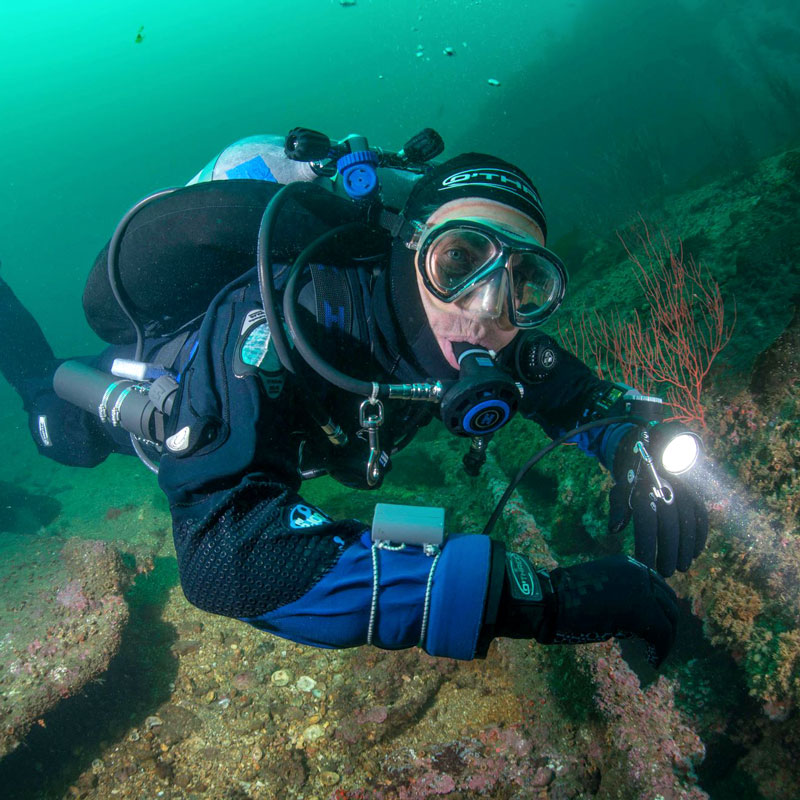
Photo by: www.tomboydimages.com
The Premise: “A Neoprene suit will create buoyancy swing”
Most tech divers here in the US won’t touch anything but Trilam suits. As you might know, I dive a lot with the GUE divers (and write for their mag) and they are dead set against neoprene suits. In fact I took a lot of shit last week when I showed up in my O’Three suit.
The suit was fantastic however, warm and comfortable. I wore it zipped up for about 6 hours on the RIB. Neoprene neck seal is comfortable and warm.
I did require an additional 3 pounds = 1.5 Kg with the suit compared to my DUI trilam and I probably can skinny that down some. However that’s on top of roughly 20 pounds = 9 kg of weight that I use with my DUI trilam suit.
So it’s a small addition and one that I think will become even smaller after a few more dives. Part of GUE thing is that their divers have excellent buoyancy & trim (by design and practice) and aren’t crawling along the wreck/cave but finning or scootering effortlessly though it.
Their argument, well here is what a GUE IT wrote to me when I emailed him after the dive (everyone else on the boat had DUI trilam suits):
Hello Mike. Thank you for the question. Compressed neoprene, crushed foam, crushed neoprene, and neoprene will all (regardless of what manufacturers claim) will compress at depth, and there will be a buoyancy swing.
This means you have to overweight yourself to get down, but at depth you will be overweight. This will create extra drag, taxing the diver gas consumption, CO2 production and inert gas absorption. I hope this answers your question.
The Reality for Mike.
Now approaching 3 years, the reality for Mike while diving is that his neoprene suit and correct under suit combination requires a near identical weight belt to a trilam and its correct under suit.
His profile is neat and streamlined and holding stops are not an issue.
Comfort and thermal properties after several hours above and below the water is superior meaning the onset of fatigue is kept at bay for longer.
Original neoprene seals are still in one piece and remain warm and dry.
Dr. Richard 'Harry' Harris
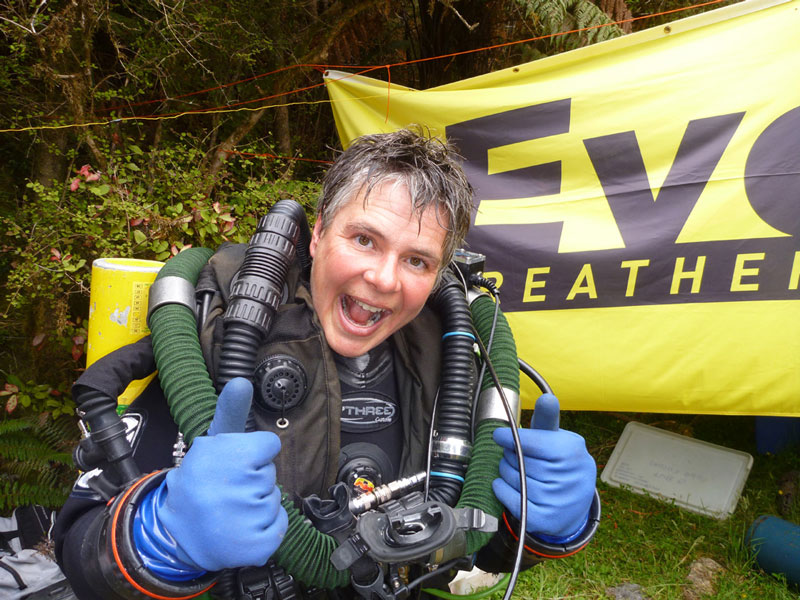
Why the Wet Mules? There is a saying in a small corner of the USA that a wealthy man has “enough money to burn a wet mule”. Ken Smith discovered this quaint phrase on one of his many working holidays around the coal mines of the United States where he meets many interesting and colourful characters.
We were quite taken with the expression, and it began to enter our conversations frequently…hungry enough to eat a wet mule, as tired as a wet mule, as wet as a wet mule etc. Then it occurred to us!
As a large part of our chosen pursuit of cave diving seems to revolve around ferrying heavy objects in and out of caves, submerging ourselves in frigid waters for many hours and generally abusing our bodies in a multitude of ways, we were beginning to take on the persona of the wet mule itself!
Stubborn, strong of back and oblivious to pain: these are the qualities of the exploration cave diver! And so the name for our small team of diverse individuals was coined… The Wet Mules!
We love: Unexplored caves; making it up as we go along, combining diving with helicopters, unique solutions to unique problems; rebreathers, SCUBA cylinders, snorkels or whatever will get the job done safely and efficiently; individualism; contributing to the science, conservation and understanding of what we enjoy…caves!



The Premise: “A Neoprene dry suit will increase fatigue”
In a nutshell, increased gas density at depth means increased resistance to the flow of gas through the airways. Increased resistance to flow, means a larger pressure drop from the alveoli to the mouth and everywhere in between.
As work increases, increased effort to exhale occurs which generates higher pressures in the chest as you “push” harder to exhale in particular. At some point, the increased pressure in the chest will be greater than the pressure in the small airways (which has dropped more than usual due to the increased gas density) and the airways will collapse, preventing the escape of gas from the lungs.
No gas movement means CO2 build up which drives the diver to breathe even harder. As soon as this starts, a vicious cycle begins and respiratory failure ensues. In other words at that point, the harder you try and breathe, the more your airways collapse and the worse the CO2 retention becomes. And so it goes…
At that point you must break the cycle or CO2 will render you unconscious. Changing to open circuit and/or ascending to decrease the gas density are the usual options.
Also, a conscious decrease in respiratory rate, increase in depth of breathing and stopping all physical effort is required. Easier said than done. SO…what is required is avoiding the problem in the first place. We try to do this by never swimming at depth (scooter only), use buoyancy aids to slow descents (never finning), concentrating on slow deep breathing, and ignoring time pressure at depth when problems arise and take as long as it takes to resolve issues (accepting the decompression penalty).
Comfort (including thermal comfort) is crucial to being able to do all this.
Fighting excessive weight or buoyancy is a real danger. Because we move slowly on the scooters streamlining is not that critical (hey, we are wearing twin Megs and two or 3 stage cylinders!). But it is critical to be warm and comfortable so a suit that is a little thicker than a trilam is of no consequence. The undergarments not the neoprene suits create most of the bulk and lift. A drop weight is good to use for the first 5m descent and during the deco so we can over inflate the suits for extra warmth. Again, a minor inconvenience when we consider how warm these suits are compared to shell / trilam suits.
The Reality for the Wetmules
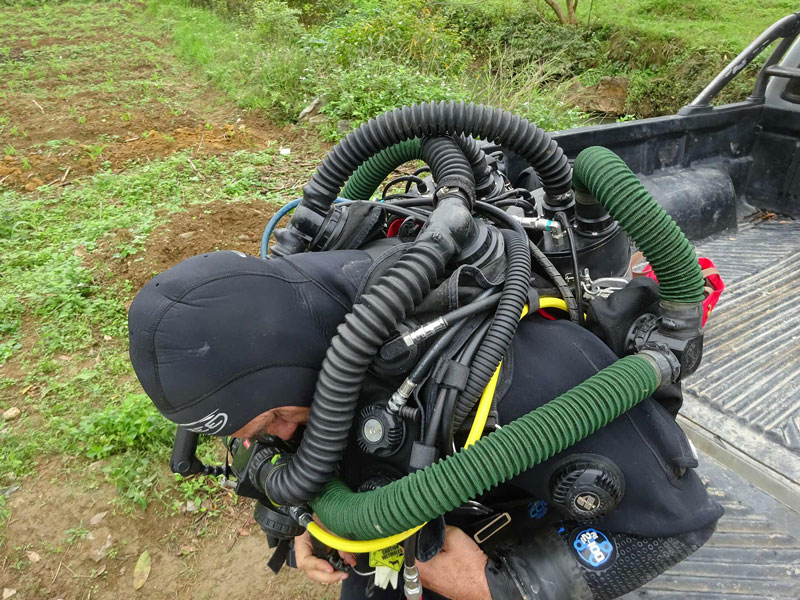
These guys and girls have adapted their equipment and their approach to suit the ground breaking type of diving they are undertaking. Their neoprene suits are a key element in helping to reduce “stop” physical effort.
Their neoprene suits are reducing not increasing fatigue. It is the neoprene that is helping to keep them alive.
A quote from the Wet Mules web site:
We dislike: Being told there is a correct way to do things, people who can’t think for themselves, over regulation and senseless red-tape, not giving credit for those who went first.
Paul Tierney
Anatomical Society | 2013 – present
Anatomical Committee of Irish Medical Schools | 2011 – present
South Pacific Underwater Medicine Society | 1996 – present
Undersea & Hyperbaric Medical Society | 1998 – present
European Underwater and Baromedical Society | 2008 – present
The Premise:
“A Neoprene suit will create buoyancy swing”
I had dived in a trilaminate drysuit for almost 18 years without a problem.
However, once I switched to open circuit trimix the limitations of trilaminate suits and holofiber undersuits became increasingly obvious.
Using heavy open circuit technical rigs, on dives longer than 150 mins resulted in cold spots developing in the undercuts that lead to significant cooling.
Then in 2006, I switched to closed circuit having exhausted the potential of open circuit trimix at 86metres.
The switch to closed circuit enabled much longer dive time, but the cooling effect of membrane suits and ‘wooly bear’ undersuit became a limiting factor.
The switch to a neoprene suit became inevitable.
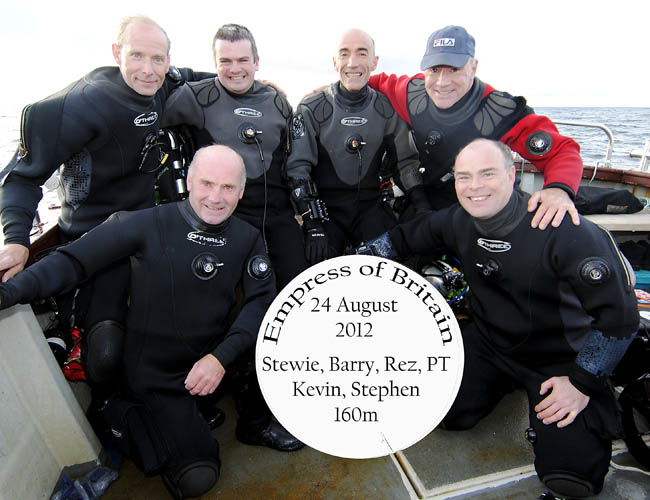
I opted for an O’Three made-to-measure neoprene suit.
Like many, I was concerned that my buoyancy would take many dives to re-establish, especially as I had opened to use a layered fleece system as underclothing.
At the start of a week of deep technical closed circuit, I took my new suit and rebreather into 6m of water with 4 extra lbs of weight to compensate for the suits extra buoyancy at the surface.
The Reality for Paul
I was fully expected to have to undergo several iterations before finalising the correct weighting. I need not have worried.
Neoprene suits are always buoyant at the surface before descending.
However once the first 4 metres has been negotiated, the neoprene suits buoyancy remains consistent and predictable.
Furthermore the same effect does not manifest itself as much during the latter stages of ascent. Therefore 6m and 3m stops are completely stable.
Finally the thermal benefits of a neoprene suit and appropriate underclothing is central in facilitating 5-6 hour dives to sub-100 metre wrecks.
I have now purchased my second made-to-measure O’Three neoprene suit and although I considered some trilaminate suits in the lead-in to making the decision, I am not convinced that membrane suits have proven their worth in deep technical diving in temperate waters.
Divers contemplating a switch, need have no concerns about buoyancy swing.